













Lesson 5: I Can Create Functions with Color Codes!
Ozobot
4
•
Computer Science, ELA, Math
•
saved
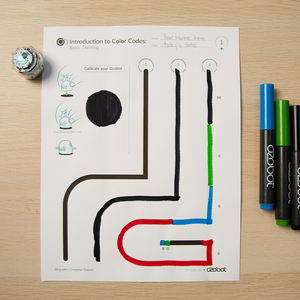
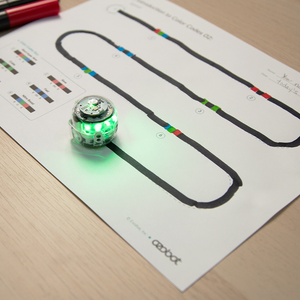
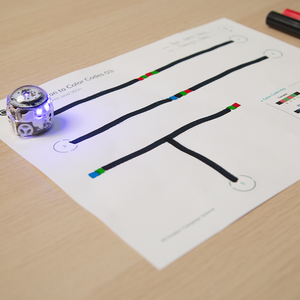
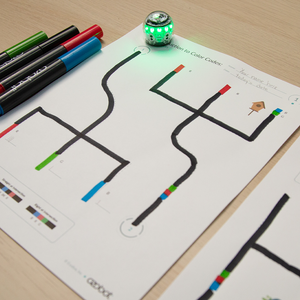
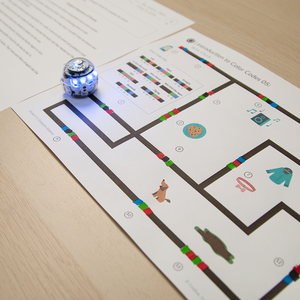
Students will be introduced to the concept of functions by using color codes to represent a function.

Color Codes
Academic Standards
CSTA 1B-CS-01 Describe how internal and external parts of computing devices function to form a system. (P7.2), CSTA 1B-CS-02 Model how computer hardware and software work together as a system to accomplish tasks. (P4.4), CSTA 1B-CS-03 Determine potential solutions to solve simple hardware and software problems using common troubleshooting strategies. (P6.2), CSTA 1B-AP-08 Compare and refine multiple algorithms for the same task and determine which is the most appropriate. (P6.3, P3.3), CSTA 1B-AP-09 Create programs that use variables to store and modify data. (P5.2), CSTA 1B-AP-10 Create programs that include sequences, events, loops, and conditionals. (P5.2), CSTA 1B-AP-11 Decompose (break down) problems into smaller, manageable subproblems to facilitate the program development process. (P3.2), CSTA 1B-AP-12 Modify, remix, or incorporate portions of an existing program into one's own work, to develop something new or add more advanced features. (P5.3), CSTA 1B-AP-15 Test and debug (identify and fix errors) a program or algorithm to ensure it runs as intended. (P6.1, P6.2), CSTA 1B-AP-16 Take on varying roles, with teacher guidance, when collaborating with peers during the design, implementation, and review stages of program development. (P2.2), CSTA 1B-AP-17 Describe choices made during program development using code comments, presentations, and demonstrations. (P7.2), ISTE 1c Students use technology to seek feedback that informs and improves their practice and to demonstrate their learning in a variety of ways., ISTE 1d Students understand the fundamental concepts of technology operations, demonstrate the ability to choose, use and troubleshoot current technologies and are able to transfer their knowledge to explore emerging technologies., ISTE 4a Students know and use a deliberate design process for generating ideas, testing theories, creating innovative artifacts or solving authentic problems., ISTE 4b Students select and use digital tools to plan and manage a design process that considers design constraints and calculated risks., ISTE 4c Students develop, test and refine prototypes as part of a cyclical design process., ISTE 4d Students exhibit a tolerance for ambiguity, perseverance and the capacity to work with open-ended problems., ISTE 5a Students formulate problem definitions suited for technology-assisted methods such as data analysis, abstract models and algorithmic thinking in exploring and finding solutions., ISTE 5b Students collect data or identify relevant data sets, use digital tools to analyze them, and represent data in various ways to facilitate problem-solving and decision-making., ISTE 5c Students break problems into component parts, extract key information, and develop descriptive models to understand complex systems or facilitate problem-solving., ISTE 5d Students understand how automation works and use algorithmic thinking to develop a sequence of steps to create and test automated solutions., ISTE 6a Students choose the appropriate platforms and tools for meeting the desired objectives of their creation or communication., ISTE 6b Students create original works or responsibly repurpose or remix digital resources into new creations., ISTE 6c Students communicate complex ideas clearly and effectively by creating or using a variety of digital objects such as visualizations, models or simulations., ISTE 6d Students publish or present content that customizes the message and medium for their intended audiences., CCSS.ELA-LITERACY.SL.4.1 Engage effectively in a range of collaborative discussions (one-on-one, in groups, and teacher-led) with diverse partners on grade 4 topics and texts, building on others' ideas and expressing their own clearly., CCSS.ELA-LITERACY.SL.4.1.B Follow agreed-upon rules for discussions and carry out assigned roles., CCSS.ELA-LITERACY.SL.4.1.C Pose and respond to specific questions to clarify or follow up on information, and make comments that contribute to the discussion and link to the remarks of others., CCSS.ELA-LITERACY.SL.4.1.D Review the key ideas expressed and explain their own ideas and understanding in light of the discussion., CCSS.ELA-LITERACY.SL.4.3 Identify the reasons and evidence a speaker provides to support particular points., CCSS.ELA-LITERACY.SL.4.5 Add audio recordings and visual displays to presentations when appropriate to enhance the development of main ideas or themes., CCSS.ELA-LITERACY.SL.4.6 Differentiate between contexts that call for formal English (e.g., presenting ideas) and situations where informal discourse is appropriate (e.g., small-group discussion); use formal English when appropriate to task and situation. (See grade 4 Language standards 1 here for specific expectations.), CCSS.ELA-LITERACY.L.4.1 Demonstrate command of the conventions of standard English grammar and usage when writing or speaking., CCSS.ELA-LITERACY.L.4.3 Use knowledge of language and its conventions when writing, speaking, reading, or listening., CCSS.ELA-LITERACY.L.4.3.A Choose words and phrases to convey ideas precisely., CCSS.ELA-LITERACY.L.4.3.C Differentiate between contexts that call for formal English (e.g., presenting ideas) and situations where informal discourse is appropriate (e.g., small-group discussion)., CCSS.MATH.CONTENT.4.OA.A.1 Interpret a multiplication equation as a comparison, e.g., interpret 35 = 5 × 7 as a statement that 35 is 5 times as many as 7 and 7 times as many as 5. Represent verbal statements of multiplicative comparisons as multiplication equations., CCSS.MATH.CONTENT.4.MD.A.2 Use the four operations to solve word problems involving distances, intervals of time, liquid volumes, masses of objects, and money, including problems involving simple fractions or decimals, and problems that require expressing measurements given in a larger unit in terms of a smaller unit. Represent measurement quantities using diagrams such as number line diagrams that feature a measurement scale.
Loading Document...