













Lesson 8: I Can Code Advanced Sequences
Ozobot
2
•
Computer Science, ELA, Math
•
saved
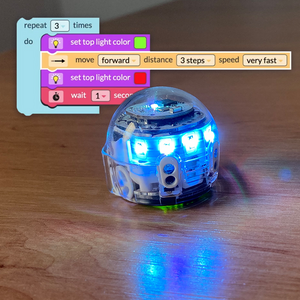
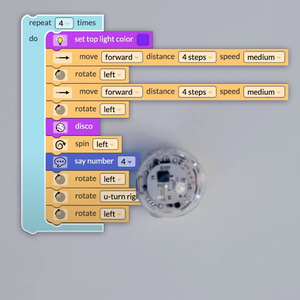
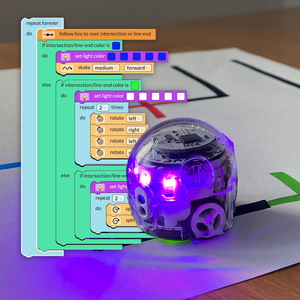
The OzoBlockly Shape Tracer will teach advanced sequencing and looping skills. Students will utilize logic, reasoning, & computer science skills.

Ozobot Blockly
Academic Standards
CSTA 1A-CS-01 Select and operate appropriate software to perform a variety of tasks, and recognize that users have different needs and preferences for the technology they use. (P1.1), CSTA 1A-CS-02 Use appropriate terminology in identifying and describing the function of common physical components of computing systems (hardware). (P7.2), CSTA 1A-CS-03 Describe basic hardware and software problems using accurate terminology. (P6.2, P7.2), CSTA 1A-DA-05 Store, copy, search, retrieve, modify, and delete information using a computing device and define the information stored as data. (P4.2), CSTA 1A-AP-08 Model daily processes by creating and following algorithms (sets of step-by-step instructions) to complete tasks. (P4.4), CSTA 1A-AP-09 Model the way programs store and manipulate data by using numbers or other symbols to represent information. (P4.4), CSTA 1A-AP-10 Develop programs with sequences and simple loops, to express ideas or address a problem. (P5.2), CSTA 1A-AP-11 Decompose (break down) the steps needed to solve a problem into a precise sequence of instructions. (P3.2), CSTA 1A-AP-12 Develop plans that describe a program’s sequence of events, goals, and expected outcomes. (P5.1, P7.2), CSTA 1A-AP-14 Debug (identify and fix) errors in an algorithm or program that includes sequences and simple loops. (P6.2), CSTA 1A-AP-15 Using correct terminology, describe steps taken and choices made during the iterative process of program development. (P7.2), CCSS.MATH.CONTENT.2.OA.A.1 Use addition and subtraction within 100 to solve one- and two-step word problems involving situations of adding to, taking from, putting together, taking apart, and comparing, with unknowns in all positions, e.g., by using drawings and equations with a symbol for the unknown number to represent the problem., CCSS.MATH.CONTENT.2.OA.B.2 Fluently add and subtract within 20 using mental strategies.2 By end of Grade 2, know from memory all sums of two one-digit numbers., CCSS.MATH.CONTENT.2.OA.C.3 Determine whether a group of objects (up to 20) has an odd or even number of members, e.g., by pairing objects or counting them by 2s; write an equation to express an even number as a sum of two equal addends., CCSS.MATH.CONTENT.2.NBT.A.2 Count within 1000; skip-count by 5s, 10s, and 100s., CCSS.ELA-LITERACY.SL.2.1 Participate in collaborative conversations with diverse partners about grade 2 topics and texts with peers and adults in small and larger groups., CCSS.ELA-LITERACY.SL.2.1.A Follow agreed-upon rules for discussions (e.g., gaining the floor in respectful ways, listening to others with care, speaking one at a time about the topics and texts under discussion)., CCSS.ELA-LITERACY.SL.2.1.B Build on others' talk in conversations by linking their comments to the remarks of others., CCSS.ELA-LITERACY.SL.2.1.C Ask for clarification and further explanation as needed about the topics and texts under discussion., CCSS.ELA-LITERACY.SL.2.4 Tell a story or recount an experience with appropriate facts and relevant, descriptive details, speaking audibly in coherent sentences., CCSS.ELA-LITERACY.SL.2.5 Create audio recordings of stories or poems; add drawings or other visual displays to stories or recounts of experiences when appropriate to clarify ideas, thoughts, and feelings., CCSS.ELA-LITERACY.SL.2.6 Produce complete sentences when appropriate to task and situation in order to provide requested detail or clarification. (See grade 2 Language standards 1 and 3 here for specific expectations.), CCSS.ELA-LITERACY.SL.2.3 Ask and answer questions about what a speaker says in order to clarify comprehension, gather additional information, or deepen understanding of a topic or issue., ISTE 1a. Articulate and set personal learning goals, develop strategies leveraging technology to achieve them and reflect on the learning process itself to improve learning outcomes., ISTE 1c. Use technology to seek feedback that informs and improves their practice and to demonstrate their learning in a variety of ways., ISTE 1d. Students understand the fundamental concepts of technology operations, demonstrate the ability to choose, use and troubleshoot current technologies and are able to transfer their knowledge to explore emerging technologies., ISTE 4a. Know and use a deliberate design process for generating ideas, testing theories, creating innovative artifacts or solving authentic problems., ISTE 4b. Select and use digital tools to plan and manage a design process that considers design constraints and calculated risks., ISTE 4c. Students develop, test and refine prototypes as part of a cyclical design process., ISTE 4d. exhibit a tolerance for ambiguity, perseverance and the capacity to work with open-ended problems., ISTE 5a. Students formulate problem definitions suited for technology-assisted methods such as data analysis, abstract models and algorithmic thinking in exploring and finding solutions., ISTE 5c. Break problems into component parts, extract key information, and develop descriptive models to understand complex systems or facilitate problem-solving., ISTE 5d. Students understand how automation works and use algorithmic thinking to develop a sequence of steps to create and test automated solutions., ISTE 6b. Students create original works or responsibly repurpose or remix digital resources into new creations., ISTE 6c. Communicate complex ideas clearly and effectively by creating or using a variety of digital objects such as visualizations, models or simulations., ISTE 6d. Publish or present content that customizes the message and medium for their intended audiences., ISTE 7 a. use digital tools to connect with learners from a variety of backgrounds and cultures, engaging with them in ways that broaden mutual understanding and learning., ISTE 7b. Use collaborative technologies to work with others, including peers, experts or community members, to examine issues and problems from multiple viewpoints., ISTE 7c. Contribute constructively to project teams, assuming various roles and responsibilities to work effectively toward a common goal.
Loading Document...